

Nov 28
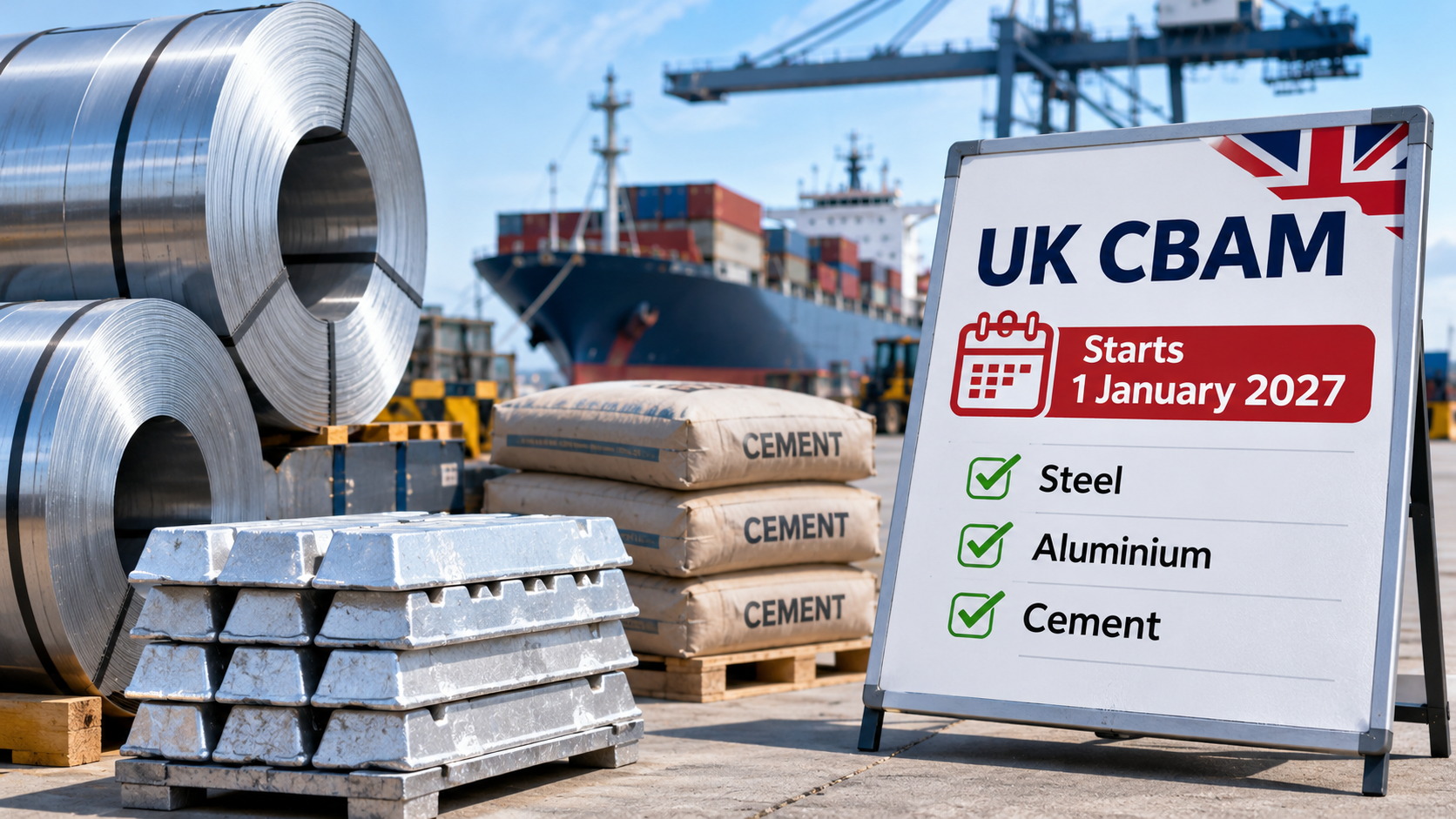
The UK Carbon Border Adjustment Mechanism (CBAM) applies to imports from 1 January 2027. If you import goods from 5 sectors into any part of the UK, including Northern Ireland, you need to know about it:
There’s no exemption for small businesses and no grace period on records. Registration opens on 1 January 2028. The first return and payment, covering the whole of 2027, is due by 31 May 2028.
The £50,000 threshold is low. It will catch builders’ merchants, fabricators, engineering firms, packaging businesses and agricultural suppliers, not just steel mills. If you import anything made of iron, steel or aluminium, check your commodity codes now and start collecting the data you’ll need. Your first return depends on records from 1 January 2027 onwards.
UK CBAM puts a carbon price on certain imported goods, so that they face a comparable cost to goods made in the UK under the UK Emissions Trading Scheme (UK ETS). The aim is to stop production simply moving to countries with weaker or no carbon pricing.
It’s a tax, run by HMRC, and it’s self-assessed on a return. That’s different from the EU CBAM, which requires importers to buy and surrender certificates. HMRC’s CBAM policy summary sets out how the regime works.
The short answer: UK CBAM covers specific goods from 5 sectors: aluminium, cement, fertilisers, hydrogen, and iron and steel. Scope is decided by commodity code, not by sector label. Some finished goods are caught too, such as steel structures, screws and bolts, and aluminium containers. Ferrous and aluminium scrap are excluded.
| Sector | Examples of goods in scope | Notable exclusions |
|---|---|---|
| Iron and steel | Iron and steel products under chapter 72, tubes and pipes, structures, sheet piling, screws, bolts, nuts, tanks, containers, other articles of iron or steel | Ferrous waste and scrap, and most ferro-alloys |
| Aluminium | Unwrought aluminium, bars, sheets, foil, tubes, structures, cans, containers, other articles of aluminium | Aluminium scrap |
| Cement | Cement clinker, Portland cement, aluminous cement, other hydraulic cements, some kaolinic clays | |
| Fertilisers | Nitric acid, ammonia, potassium nitrates, nitrogenous fertilisers, most mixed fertilisers | Fertilisers containing only phosphorus and potassium |
| Hydrogen | Hydrogen |
Electricity, glass and ceramics are not included at the start.
Use HMRC’s guidance to check which goods are in scope of CBAM by commodity code. We often see businesses assume that because they don’t import raw steel, CBAM doesn’t concern them. A company importing steel fixings, aluminium window frames or packaged fertiliser can easily be caught.
The person liable for CBAM is the importer of the goods. That’s the person in whose name the customs declaration is made, or on whose behalf it’s made. Where no customs declaration is needed, it’s the person on whose behalf the goods are imported.
You can appoint a tax agent to submit returns, but the agent can’t register for you and doesn’t take on the liability. If you buy on delivered terms and your supplier is the importer of record, the liability sits with them. Check your Incoterms.
There are 2 tests, and meeting either one makes you liable to register:
The value is the customs value of the goods, the same figure used for import duty. It’s not the emissions or the tax.
Here’s an example. A Northern Ireland fabrication business imports £30,000 of steel sections in April 2027 and another £25,000 in September. On 1 October 2027, the backward test shows £55,000 of CBAM goods since 1 January, so the business becomes liable. It has until 31 January 2028 to register, and its first return covers 2027.
| Date | What happens |
|---|---|
| 1 January 2027 | CBAM applies to goods imported from this date. Start keeping records |
| Each quarter from 1 January 2027 | CBAM rates are published for each sector |
| 1 January 2028 | HMRC registration opens |
| 31 January 2028 | Deadline to register if you became liable during 2027 |
| 31 May 2028 | First return and payment due, covering 1 January to 31 December 2027 |
| From 1 January 2028 | Quarterly accounting periods begin |
| 31 July 2028 | Return and payment due for January to March 2028 |
After 2027, you’ll file and pay quarterly. The deadline gradually moves to 2 months after the end of each quarter.
The calculation has 3 parts:
| Step | What you calculate |
|---|---|
| 1. CBAM charge | Embodied emissions in the goods, in tonnes of CO2 equivalent, multiplied by the CBAM rate for that sector |
| 2. Carbon price relief | Any qualifying carbon price already paid on those emissions overseas |
| 3. CBAM liability | The CBAM charge minus carbon price relief, which can’t go below nil |
The charge is based on direct emissions embedded in the goods, including the emissions from relevant precursor goods. You can work out embodied emissions in 2 ways:
You multiply the emissions intensity by the net weight of the goods imported, excluding packaging, recorded in kilograms.
Default values are simpler, but they’re designed to be cautious. If your supplier’s actual emissions are lower, verified data could reduce your tax. Getting that data from overseas mills, often through traders or distributors, is the hard part.
There’s a single rate for each sector, set every quarter by reference to UK ETS auction prices. It’s then adjusted to reflect the free allowances UK producers still receive. You use the rate that applied when the goods were imported. GOV.UK publishes the rates for CBAM each quarter.
If the goods were subject to a qualifying carbon price in the country of production, such as a carbon tax or emissions trading scheme, you can claim relief. You’ll need a carbon pricing verification form completed by an accredited verifier for the producing installation. Overseas amounts are converted into sterling using HMRC exchange rates from the previous quarter.
UK CBAM applies across the whole of the UK, including Northern Ireland. The EU CBAM does not apply in Northern Ireland, even though Northern Ireland follows EU rules for goods under the Windsor Framework.
| Scenario | Which CBAM applies |
|---|---|
| Steel imported into Northern Ireland from outside the UK and EU | UK CBAM |
| CBAM goods originating outside the UK, brought into Northern Ireland | UK CBAM, as there is currently no exemption for any country |
| Goods made in the UK | Not in scope of UK CBAM |
| Union goods sent from Northern Ireland to the EU and returned within 3 years in the same state | No UK CBAM liability, if conditions are met |
| Goods moving from Northern Ireland into the EU | EU CBAM doesn’t apply to goods placed on the EU market from Northern Ireland |
| Goods exported from Great Britain to the EU | The EU importer deals with EU CBAM |
There’s currently no exemption for goods from the EU. The UK and EU are negotiating to link their emissions trading systems. If that’s agreed and brought into law, it should create the conditions for mutual exemption from each other’s CBAMs. Until then, EU-origin CBAM goods entering the UK can be subject to UK CBAM.
If you buy steel, aluminium or fertiliser from suppliers in the Republic, you’ll need to check where those goods were produced and who counts as the importer. Movements between Ireland and Northern Ireland often have no customs declaration, so it’s easy to overlook. Our cross-border accounting and tax team can help you work through how CBAM applies to your supply chain on both sides of the border.
In our experience working with Northern Ireland businesses, CBAM-type goods turn up in more supply chains than people expect. Businesses likely to need to look closely include:
If you buy from a UK distributor that imports the goods, you won’t be the liable person. But the cost will almost certainly be passed on to you, so it’s still worth understanding.
You can’t register until January 2028, but the work that decides how much you pay starts now:
Good records are the foundation. Our digital bookkeeping services can help you capture import data alongside your existing accounts, so CBAM doesn’t become a separate spreadsheet exercise.
HMRC will use its existing powers and penalties for CBAM. Penalties apply for failing to register, failing to file or pay, and errors in returns. There’s also a new general penalty for other failures and criminal offences for deliberate evasion. HMRC can also assess the tax and register businesses compulsorily if they don’t come forward.
For larger importers, an internal audit review of customs data, commodity classification and CBAM record keeping can catch errors before HMRC does. Misclassified commodity codes are a common source of customs problems and will now affect CBAM too.
CBAM liabilities will also need to be reflected in your accounts. That includes accruals at the year end for imports not yet reported, which your external audit team will want to see properly supported.
Where you suspect that origin or emissions data from a supplier is unreliable, or that goods have been deliberately misdescribed, an independent review from our forensic accounting team can help you understand the exposure.
CBAM is designed to raise the cost of high-carbon imports. For businesses with thin margins, such as some construction contractors and merchants, that could squeeze profitability, particularly on fixed-price contracts signed before the cost was known. If CBAM adds to existing pressure on cash flow, it’s better to plan early. Our business recovery and restructuring team can help you look at the options.
There may also be opportunities. Some businesses will look at switching to lower-carbon suppliers, increasing UK sourcing, or developing new processes that use less carbon-intensive material. Where that involves genuine technical development, it may qualify for R&D tax relief.
UK CBAM applies to goods imported into the UK on or after 1 January 2027. Registration with HMRC opens on 1 January 2028. If you became liable during 2027, you have until 31 January 2028 to register. Your first return and payment, covering all of 2027, is due by 31 May 2028.
Yes. UK CBAM applies across the whole of the UK, including Northern Ireland. The EU CBAM doesn’t apply in Northern Ireland. There’s a specific relief for Union goods sent from Northern Ireland to the EU and returned to the UK within 3 years in the same state.
You must register once the customs value of your CBAM goods reaches £50,000. That’s measured either over the previous 12 months, checked on the first day of each month, or the next 30 days if you expect to import that much. During 2027, the backward test only looks back to 1 January 2027.
UK CBAM is a tax self-assessed on an HMRC return, with a £50,000 value threshold. EU CBAM requires importers to buy and surrender certificates, with a 50-tonne annual mass threshold. EU CBAM also covers electricity. The UK and EU are negotiating an emissions trading link that could lead to mutual exemption.
UK CBAM is a new tax with a low threshold, and the records you need for your first return start building from 1 January 2027. Checking your commodity codes, supplier data and import arrangements now will make 2028 much more manageable.
SCC helps businesses across Northern Ireland, Ireland and the UK understand new tax obligations and build the processes to meet them. Talk to our cross-border tax and sustainability specialists about assessing your CBAM exposure and preparing for registration.
Contact us to find out more about SCC services
NI:
UK
ROI:
Email Address:
Friday

Jun 1

Jan 5
Our award-winning team across our offices in the UK and Ireland collaborates to deliver the highest standards in a fast moving and evolving manner.


