

Mar 11
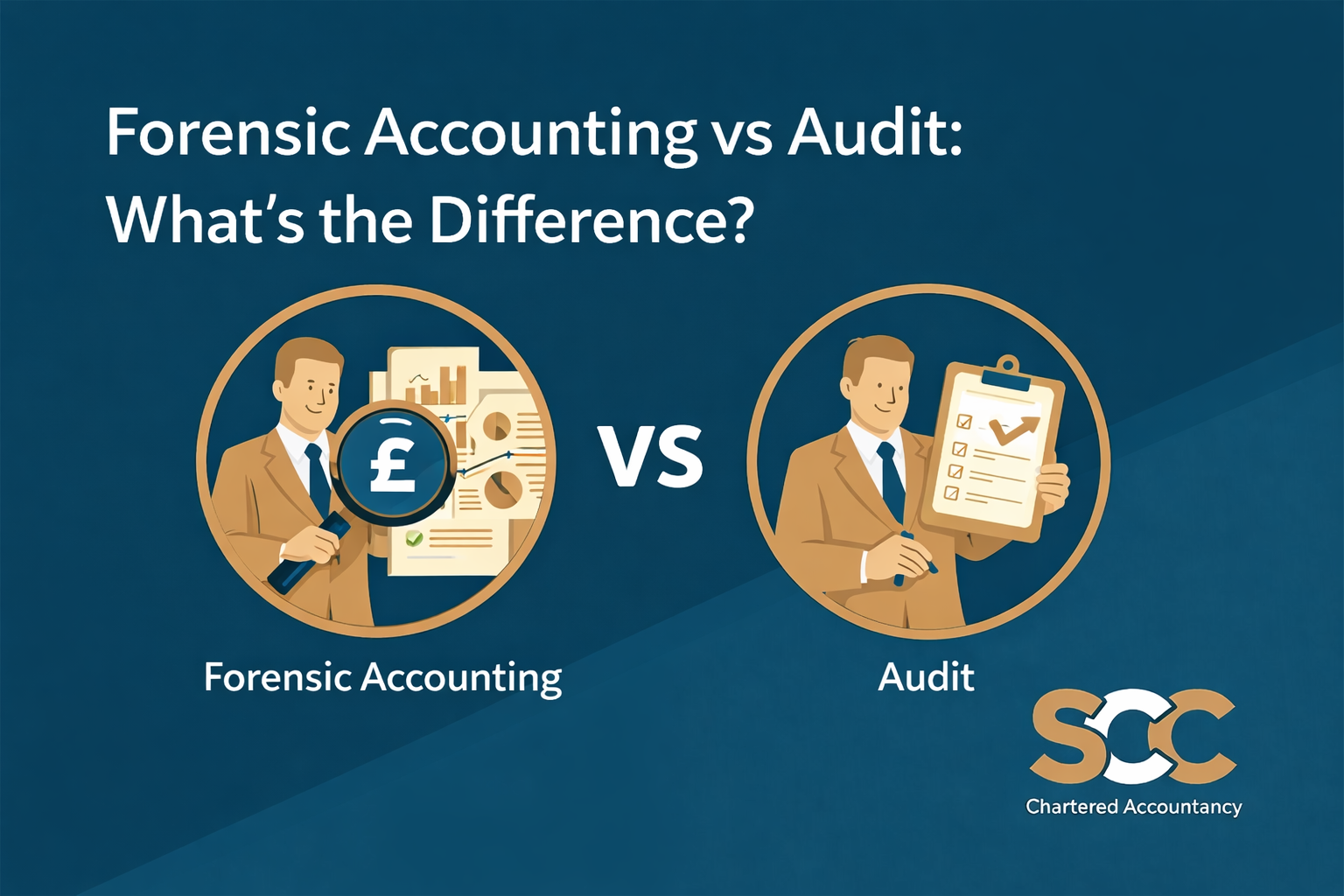
If you are trying to understand whether your business needs an audit or a forensic accountant, it is easy to assume they do broadly the same thing. After all, both involve accountants, financial records, testing, and professional judgement. In practice, though, they are used for very different reasons. An audit is mainly about independent assurance on financial statements and controls, while forensic accounting is usually about investigating specific issues, disputes, losses, or suspected wrongdoing.
Knowing the difference matters. If you bring in the wrong type of support, you can spend time and money without getting the answers you actually need. If you choose the right one from the start, you can deal with risk more efficiently, make better decisions, and protect your business more effectively.
An audit is a structured assurance exercise. In the UK, statutory audit sits within a legal framework under Part 42 of the Companies Act 2006 and related regulations, with the Financial Reporting Council overseeing key parts of audit regulation. The purpose of an external audit is not to run a full investigation into every transaction. It is to give an independent opinion on whether a company’s financial statements present a true and fair view in line with the relevant reporting framework.
That is why a business will often need an audit because of legal requirements, investor expectations, lender requirements, or governance reasons. SCC’s External Audit service reflects that role clearly, focusing on high-assurance audits that provide confidence in your company while aiming to minimise disruption to day-to-day operations.
There is also a separate but related role for Internal Audit. Internal audit is not the same as statutory external audit. It looks more closely at your organisation’s risk management, governance, and internal control framework to assess whether these are operating effectively. That can be particularly useful if you want stronger oversight, improved controls, or better fraud prevention processes.
Forensic accounting is much more investigative. It is usually used when there is a problem to examine, a dispute to resolve, a loss to quantify, or evidence to analyse. Rather than asking whether financial statements can be relied on overall, forensic accounting usually asks more targeted questions such as: What happened? Where did the money go? Was there financial misconduct? What is the value of the loss? What is the business worth for the purpose of a dispute or settlement?
SCC’s Forensics & Investigations service covers exactly this kind of work. Their forensic team works across areas including fraud and crime investigation, matrimonial matters, business dispute resolution, forensic M&A services, due diligence, and business valuation. The service is also positioned to support legal disputes and expert witness work across the UK and Ireland.
So while audit is generally about assurance, forensic accounting is about investigation and evidence.
The clearest difference comes down to why the work is being done.
If your aim is to improve trust in financial reporting, meet statutory requirements, or give shareholders and lenders reassurance, you are usually looking at audits. If your aim is to uncover facts, investigate suspicions, assess a claim, or support legal proceedings, you are usually looking at forensic accounting.
That distinction sounds simple, but it makes a real difference in practice. For example, if you suspect funds have been diverted, or there is a shareholder dispute over business value, a standard audit is unlikely to answer all of your questions. In contrast, if your main concern is compliance, reporting quality, and stakeholder confidence, a forensic assignment may be more than you actually need.
An audit usually follows a recognised methodology. The auditor plans the work, assesses risk, tests selected transactions and balances, reviews systems and controls, and then forms an opinion. Sampling is a normal part of that process. The work is not designed to review every single item.
Forensic accounting tends to be far more bespoke. The work might involve tracing transactions, reviewing emails and supporting records, reconstructing incomplete accounting information, assessing related-party dealings, valuing a business, or quantifying financial loss. The scope is driven by the issue you need to resolve, not by a standard audit opinion.
That is also why forensic work often overlaps with services such as Corporate Finance where valuation issues arise, or Recovery & Restructuring if financial problems and disputes begin to affect the stability of the business. SCC also offers SME Business Solutions for businesses that need broader commercial and finance support alongside more specialist advice.
Sometimes, yes. But that does not mean an audit is a fraud investigation.
Auditors are expected to consider the risk of material misstatement due to fraud as part of their work. However, an audit does not guarantee that all fraud, all errors, or all misconduct will be identified. The focus is on whether the financial statements as a whole are materially misstated. A forensic accountant, by contrast, may be instructed specifically to investigate suspected fraud, preserve evidence, and quantify the impact.
This is a common source of confusion. You may hear someone ask why an audit did not “catch everything”, when in reality the business needed a targeted investigation rather than a standard assurance engagement.
You are more likely to need an audit if:
It is also worth noting that not every private limited company needs a statutory audit. For financial years beginning on or after 6 April 2025, a private company may qualify for audit exemption if it meets at least 2 of the following 3 thresholds: turnover of no more than £15 million, assets of no more than £7.5 million, and 50 or fewer employees on average. Even where you qualify for exemption, though, there can still be good commercial reasons to seek audit or assurance support.
If your main concern is keeping reporting accurate and compliant, support such as Tax Compliance or Digital Tax may also sit alongside your audit needs.
You are more likely to need forensic accounting if:
For tax-related serious fraud matters, HMRC’s Code of Practice 9 is a good example of where specialist investigative support is crucial. HMRC states that COP9 is used in civil investigations where it suspects fraud, which is very different from a routine tax compliance matter. In cases like that, it is often sensible to combine forensic expertise with Specialist Tax advice and, where relevant, Cross-Border Accounting & Tax support. SCC’s cross-border service is specifically built around UK and Ireland expertise, which can be especially useful if financial structures or tax exposures span more than one jurisdiction.
The better you understand the difference, the easier it is to get the right help.
Audit gives you assurance. Forensic accounting gives you investigation. Audit helps improve confidence in reporting and controls. Forensic accounting helps establish facts, value losses, and support disputes. In some situations, you may even need both. For example, you might begin with Forensics & Investigations to understand what went wrong, then use Internal Audit to strengthen controls and reduce the risk of the same issue happening again. You may also bring in Sustainability advice where governance and reporting improvements form part of a wider business strategy.
If you want a simple way to remember it, think of it like this: audit is about reassurance, and forensic accounting is about resolution.
If you need independent confidence in your accounts, governance, and controls, audit is usually the right route. If you need to investigate a financial issue, support a dispute, value a business, or follow the evidence behind a concern, forensic accounting is usually the better fit.
If you are not sure which approach your situation calls for, speak to SCC through their Contact Us page. With expertise across External Audit, Internal Audit, Forensics & Investigations, Corporate Finance, and Cross-Border Accounting & Tax, you can get advice that matches the real issue in front of you and helps you move forward with confidence.
Contact us to find out more about SCC services
NI:
UK
ROI:
Email Address:
Friday

Jun 1

Jan 5
Our award-winning team across our offices in the UK and Ireland collaborates to deliver the highest standards in a fast moving and evolving manner.


